


16 Oct Coping With Pet Loss and Grief: Finding Your Own Way Through
Coping with pet loss and grief can be all encompassing, and it’s something I have experienced personally.

How to cope with pet loss? If you’ve had a pet and lost a pet it will be a question you have asked yourself at some point.
Losing a pet can hurt in a way that is incredibly difficult to explain, unless it’s been experienced first hand.
Pets are woven into the fabric of our everyday lives. The sound of their paws, the place they sleep, the routines built around feeding them, opening doors for them, talking to them and simply knowing they are there.
When they die, we don’t only lose the animal we love. We lose all of those tiny moments too.
When we lost our cat Mimi this year, I experienced the intensity and complexity of pet grief for myself. There was sadness, but there was also guilt, helplessness, fear and even the pain of feeling rejected when her natural instinct was to withdraw.
I didn’t want to simply try to “get over” her death. I needed ways of allowing the grief to exist, expressing it and finding somewhere for all of those feelings to go.
For me, that included painting, writing, ritual, EFT, spending time at The Ivy, my private retreat space in Nottingham, and ultimately allowing myself to grieve rather than trying to make the grief disappear.
There isn’t one correct way to grieve a pet.
Sometimes we need to talk. Sometimes we need to cry. Sometimes we need ritual or creativity. And sometimes we simply need somewhere quiet enough to feel what we’re feeling.
Why does losing a pet hurt so much?
The relationship we have with an animal can be one of the safest and least complicated relationships in our lives.
Our pets don’t require us to perform.
They don’t care whether we’ve been productive, whether we’re successful, whether the house is tidy or whether we’re having a terrible day.
They are simply there.
For some people, particularly those who are neurodivergent, have experienced difficult relationships or simply find enormous safety in their relationship with animals, that connection can be particularly significant.
And yet pet grief isn’t always given the same recognition as other bereavements.
People may expect us to return to normal quickly or say things such as, “You can get another one.”
But grief doesn’t work like that.
You aren’t grieving a pet.
You’re grieving your pet.
A particular relationship, personality, routine and chapter of your life that cannot simply be replaced.
The night I knew Mimi was dying
Mimi had been unwell for over eight weeks. The vet suspected a tumour on her kidney.
There had been tests, medication and frequent trips backwards and forwards to the vets as we tried to understand what was happening and help her. After spending around £3000 on vets bills I had to decide whether I was just prolonging the inevitable.
Then one night she deteriorated rapidly.
Her organs were failing. She stopped eating and drinking and I spent the entire night on the floor weeping beside her.
Like many animals who are very poorly, Mimi’s instinct was to withdraw and be left alone.
Intellectually, I could understand that.
Emotionally, it was incredibly painful.
My Rejection Sensitive Dysphoria (RSD) was hugely triggered and had been triggered for weeks as she tried to find somewhere she could be left alone. The animal I desperately wanted to comfort was communicating that she wanted space. I had to keep reminding myself that this wasn’t Mimi rejecting me. She was dying and following an instinct that had nothing to do with how much she loved me.
By 6am, I knew I needed help.
I emailed Laura Rainbow Bridge Vet, a home euthanasia service in Nottingham. Within a couple of hours Laura had responded and found a time to come that same afternoon, despite it being the weekend and incredibly short notice.
I cannot adequately describe the relief I felt knowing that I didn’t have to put Mimi through another day. Every hour the pain inside me increased as I absorbed myself in hers, and I almost willed her to pass naturally.
When grief becomes guilt
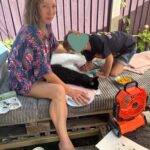
I had to leave the house briefly that morning, so a friend came and sat with Mimi because I couldn’t bear the thought of her being alone.
When I returned, the grief completely encompassed me.
I was bereft and crying uncontrollably.
Mimi was barely breathing. I lay beside her knowing that she was ready to leave and knowing there was nothing more I could do to make her better.
It was one of the hardest experiences of my life.
And alongside the grief came guilt.
I began thinking about all of those vet appointments.
Had I put her through too much? I still cry thinking about her wincing at being prodded with another needle when she was so fragile.
Had I prolonged her pain because I wasn’t ready to let her go?
Should I have realised sooner?
This is one of the cruellest parts of grief: our brain can take decisions that were made through love and retrospectively put them on trial.
We look backwards with information we didn’t have at the time and ask ourselves to prove that every decision was right.
Often there simply isn’t that certainty.
Painting and writing while I waited
As I sat with Mimi that morning, I needed somewhere for the emotion to go. These final hours were cherished as I fully absorbed myself in grief.
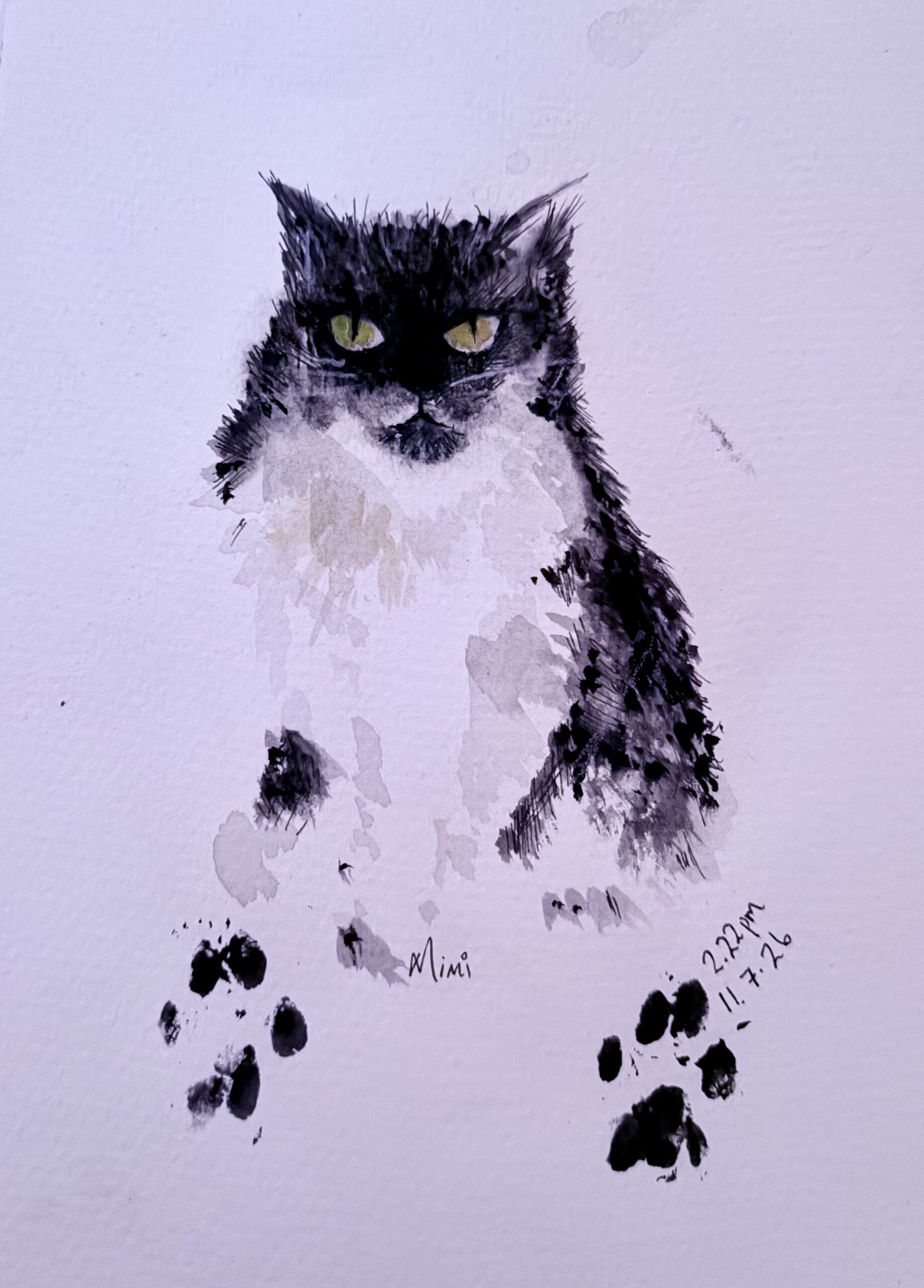
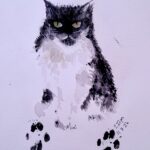
So I painted her in watercolour.
And I wrote her a letter.
I wasn’t creating art to produce something beautiful. I wasn’t writing because I needed the right words.
I was doing something with my hands while my heart was breaking.
Those acts gave me a way to stay connected to her and express something that I couldn’t contain through thought alone.
This is something I now think is particularly important when we talk about grief.
We don’t only process emotion by talking.
We can paint it.
Write it.
Move it.
Tap through it.
Create ritual around it.
Sit quietly beside it.
Sometimes the process matters far more than whatever we create.
Saying goodbye to Mimi at home
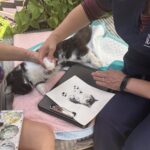
When Laura arrived, she was sensitive, gentle and calm.
She explained the process to me and, importantly, didn’t rush my goodbye.
I kept one hand on Mimi while Laura administered the sedative. Mimi was already extremely weak and her heart stopped peacefully before being given the drug to put her to sleep.
She was at home.
She wasn’t being transported again. She wasn’t surrounded by unfamiliar sounds and smells. I was beside her, touching her.
That mattered enormously to me.
Laura then left me with Mimi and gave me the space I needed.
I lay beside her for another couple of hours.
I talked to her.
I cried.
I covered her body with flowers.
And when I was ready, I wrapped her gently in a cotton sheet.
I will always be grateful to Laura for responding so quickly, accommodating us on a weekend at such short notice and, most importantly, for the care and sensitivity she brought into our home at one of the most painful moments of my life.
Being able to say goodbye to Mimi at home turned an unavoidable death into something gentler.
Returning Mimi to the earth
A friend had dug a grave for me because I simply wasn’t in a place where I could manage that myself.
Later, my sister came to help me put Mimi to rest.
We created our own little ceremony.
I buried her with herbs, leaves and flowers, and a painting from Edith.
Then we returned her to Mother Earth.

There was something incredibly important to me about that physical act.
I wasn’t trying to make the loss beautiful. It wasn’t beautiful. I was heartbroken.
But ritual gave me something to do with the goodbye.
Mimi’s burial also gave me a physical place connected with her that remains part of home.
Other people may choose cremation, keep ashes, scatter them somewhere meaningful or create a memorial in an entirely different way.
There is no correct ritual.
The question is simply:
What feels meaningful to you?
Grief isn’t only sadness
One of the reasons grief can feel so overwhelming is that it rarely arrives as one neat emotion.
Pet loss can bring sadness, but it can also bring guilt, anger, relief, regret, loneliness and helplessness.
You may feel guilty that you didn’t notice something sooner.
You might question whether euthanasia happened too early or too late.
You can feel relieved that your pet isn’t suffering anymore and then feel guilty for experiencing relief.
You might even feel angry with your pet for leaving you.
And then feel terrible for thinking it.
Two apparently opposing feelings can both be true.
I could know that I had spent weeks trying to help Mimi while simultaneously feeling guilty that those attempts might have prolonged her discomfort.
I could understand why she wanted to withdraw while still experiencing her withdrawal as rejection.
Grief doesn’t always behave logically.
Part of processing it can be learning that we don’t necessarily need to argue with every feeling. Sometimes we need to acknowledge it and regulate ourselves enough to allow it to move through us.
Pet grief, ADHD, autism and RSD
As an AuDHD woman, my experience with Mimi also made me think more deeply about neurodivergence and grief.
ADHD and autistic people can experience emotion, attachment, changes in routine and sensory experiences differently. Emotional regulation can already require considerable energy.
A pet may also be part of the structure of your day and an important source of comfort and regulation.
Suddenly their bowl is still there.
Their favourite place is empty.
You automatically expect to see them when you walk through the door.
Those repeated reminders can be incredibly painful.
For me, RSD added another layer.
Even while Mimi was dying, her instinctive need to withdraw triggered feelings of rejection in me. Rationally knowing why she was doing it didn’t simply switch those feelings off.
RSD can also feed the rumination that often accompanies grief:
I should have noticed sooner.
I let them down.
I should have done more.
What if I made the wrong decision?
Those thoughts can become loops.
This is why neurodivergent grief support sometimes needs to consider far more than sadness. We may need help with regulation, guilt, rumination, disrupted routines, sensory reminders and the intensity with which we’re experiencing the loss.
Using EFT to regulate overwhelming grief
One of the tools I use personally and professionally is Emotional Freedom Technique (EFT), sometimes called tapping.
When grief feels enormous, trying to reason ourselves out of it isn’t always particularly helpful.
EFT gives us something physical to do while acknowledging what we’re actually experiencing.
Rather than forcing ourselves towards I’m fine, we might begin with something truthful:
“Even though this hurts so much right now, I can acknowledge what I’m feeling.”
Or:
“Even though part of me feels guilty, I’m willing to be curious about what that guilt needs me to know.”
Or perhaps:
“Even though I keep questioning whether I did enough, everything I did came from loving them.”
The purpose isn’t to tap away grief.
Grief exists because the relationship mattered.
Instead, EFT can be used as a regulation tool when the intensity of an emotion becomes difficult to hold.
Art, writing and ritual for processing pet loss
You don’t need to be artistic, spiritual or good at writing to use creativity in grief.
Nobody even needs to see what you create.
Some ways you might honour your pet include:
- Write your pet a letter saying everything you still want them to know.
- Paint or draw them without worrying about whether the finished picture is “good”.
- Plant a tree, flower, herb or plant in their memory.
- Create a memory box with photographs, their collar or favourite toy.
- Make a photo book that includes the ordinary, funny photographs as well as the perfect ones.
- Light a candle on meaningful dates.
- Create a small altar or memory corner.
- Press flowers or leaves from somewhere connected to them.
- Donate food, blankets or money to an animal charity in their name.
- Create your own goodbye ceremony or burial ritual.
- Write down all their strange habits and funny little things you’re frightened you might forget.
Children can be involved too.
Edith’s painting being buried with Mimi became part of our goodbye.
Ritual can give adults and children something tangible to do with an experience over which we otherwise have very little control.

Finding a quiet place to grieve
I also used The Ivy during my own grieving process.
I created The Ivy as a private retreat space where there is permission to stop doing and simply be.
Grief can be exhausting because ordinary life doesn’t stop while we’re experiencing it.
There are still emails.
Work.
Washing.
School runs.
Appointments.
People needing things.
Sometimes we need somewhere away from those demands.
At The Ivy, grief doesn’t have to be productive.
You might journal, create something, sit outside, cry, sleep, use EFT, have a therapeutic session or simply experience some quiet.
That pause can itself be part of processing loss.
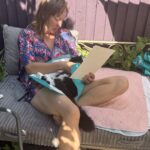
Reading Mimi my letter
Can hypnotherapy help with pet grief?
Hypnotherapy can offer another gentle way of working with grief, particularly when thoughts and emotions feel relentless.
I don’t use hypnosis to make somebody forget their pet or to tell them that they shouldn’t be grieving.
Instead, hypnotherapy can create a deeply relaxed space in which we can work with memories, emotions and our internal connection to an animal we have lost.
For some people, imagining their pet healthy and comfortable again in an after life can feel soothing.
You might reconnect with the feeling of their fur, the sound they made, their personality, a favourite memory or simply the feeling of sitting peacefully beside them.
The physical relationship has ended.
The emotional relationship and everything it gave us doesn’t suddenly cease to exist.
Coping with pet loss and grief – You don’t have to “get over” your pet
I don’t particularly like the idea that grief is something we should complete and leave behind.
I think we learn how to carry loss differently.
Eventually a photograph that made us sob may make us smile.
A memory that felt unbearable may become comforting.
There isn’t a timetable for when that should happen.
If you’re struggling after losing a pet, particularly if you’re experiencing guilt, anger, rumination, RSD or emotions that feel too big to manage alone – I offer one-to-one pet loss and grief support as part of my coaching and therapeutic work.
I draw on conversation, emotional regulation strategies, EFT, hypnotherapy and creative approaches depending on what feels right for the individual.
You can also spend time at The Ivy, my private solo retreat in Nottingham, where there is space to pause, create, reflect and process loss without having to rush back into everyday life.
Losing Mimi reminded me that healing isn’t about trying to erase grief.
I wouldn’t want to erase something that exists because I loved her.
Sometimes healing is about creating enough safety and space to sit beside our grief, express it in whatever way we need to, and slowly find a different way of carrying the love that remains.
RIP Mimi I am so grateful that you chose to spend your final years with us and for all the love you gave to me, Edith and my clients as you naturally took on the role of therapy cat!
If you want to discuss how I can support you coping through pet loss and grief, you can request a free call with me here